Latest Info on Newzealand gov spend, Public Purchasing, Govt budget & Public spending
- Home >
- Public Procurement
Public Procurement in New Zealand
Public Procurement in New Zealand is a strategically governed, principles-based system that plays a significant role in public service delivery, infrastructure development, and inclusive economic growth within a high-income economy. Government procurement represents a substantial share of public expenditure and is used as a policy lever to support sustainability, social outcomes, and innovation.
The procurement framework is administered centrally by the Ministry of Business, Innovation and Employment (MBIE) and applies across central government agencies. Procurement rules emphasize transparency, value for money, open competition, and responsible procurement practices.
For domestic suppliers and international firms, government tenders in New Zealand provide structured access to a mature, digitally enabled, and rules-based procurement market.
Country & Economic Overview
| Country | New Zealand |
| Region | East Asia and Pacific |
| Population | 5,300,000 (2024) |
| Income Level | High-income economy |
| Currency | New Zealand Dollar (NZD) |
| GDP | USD 255.0 billion (2024) |
| GNI | USD 247.0 billion (2024) |
| GNI per Capita | USD 46,600 (2024) |
New Zealand’s economy is service-oriented, export-driven, and institutionally strong. Public procurement represents approximately 20% of GDP, making it a key mechanism for delivering government priorities and achieving long-term economic and social outcomes.
Public Procurement Governance Framework
The public procurement system in New Zealand is centrally guided and coordinated through MBIE.
| Public Procurement Agency (PPA) | Ministry of Business, Innovation and Employment |
| Central Purchasing Body | Yes |
| Relevant Ministry | Ministry of Business, Innovation and Employment |
MBIE is responsible for issuing procurement rules, policy guidance, and oversight, while individual agencies conduct procurement activities in accordance with the Government Procurement Rules.
Legal & Regulatory Framework
The public procurement law in New Zealand is governed by the Government Procurement Rules, supported by the Government Procurement Charter and related guidance documents.
- Total Cost of Ownership: Rule 8
- Life Cycle Costing: Rule 46
- Value for Money: Rule 46
- Sustainability: Rule 20
- Complaint Resolution: Rule 50
- Contract Award Disclosure: Rule 48
The framework is principles-based and allows flexibility while ensuring accountability, fairness, and proportionality in procurement decisions.
Procurement Procedures & Thresholds
Procurement thresholds and procedures are defined under the Government Procurement Rules.
- Tender Thresholds: Rules 6 and 7
- Direct Contracting (Goods & Services): Rule 6
- Direct Contracting (Works): Rule 7
- Advertisement Period: Rules 29-31
Standstill and bid validity periods are not explicitly standardized and are typically specified in tender documentation.
E-Procurement System in New Zealand
New Zealand operates a long-established national e-procurement platform that supports end-to-end digital procurement.
| System Name | New Zealand Government Electronic Tenders Service (GETS) |
| Launch Year | 2002 |
| Website | https://www.gets.govt.nz/ExternalIndex.htm |
| Functionalities | ePublishing, eTendering, eContract Management, Vendor Management |
| Tender Documents | Downloadable |
The system supports classification using the United Nations Standard Products and Services Classification (UNSPSC).
Procurement Market Characteristics
The public procurement market in New Zealand is competitive and policy-driven, with increasing emphasis on inclusive and sustainable procurement.
- Procurement is predominantly conducted through open and advertised tenders.
- Digital procurement is the standard mode of engagement.
- Evaluation emphasizes value for money rather than lowest price alone.
Transparency, Complaints & Oversight
Transparency is ensured through mandatory publication on GETS. Suppliers may raise concerns and complaints in accordance with Rule 50 of the Government Procurement Rules.
Sustainability & Green Public Procurement
Sustainability is a core principle of New Zealand’s procurement system. Rule 20 enables agencies to integrate environmental, social, and economic sustainability considerations into procurement decisions.
Social & Ethical Procurement Considerations
The Government Procurement Rules and Charter promote inclusive procurement. Provisions support awards to women-owned businesses and disadvantaged groups, ethical sourcing, and adherence to international labour standards.
A spend target of 8% is set for women-owned businesses under inclusive procurement objectives.
Key Challenges & Practical Insights for Bidders
- Strong compliance with Government Procurement Rules required
- High emphasis on value, sustainability, and social outcomes
- Competitive bidding environment
- Detailed documentation and transparency expectations
Practical bidding tips
- Register and monitor opportunities on GETS regularly.
- Align bids with value for money and sustainability principles.
- Demonstrate compliance with ethical and labour standards.
- Prepare clear and proportionate documentation.
Overall, Public Procurement in New Zealand offers a transparent, digitally advanced, and policy-oriented procurement environment that rewards compliant, value-driven, and socially responsible suppliers.
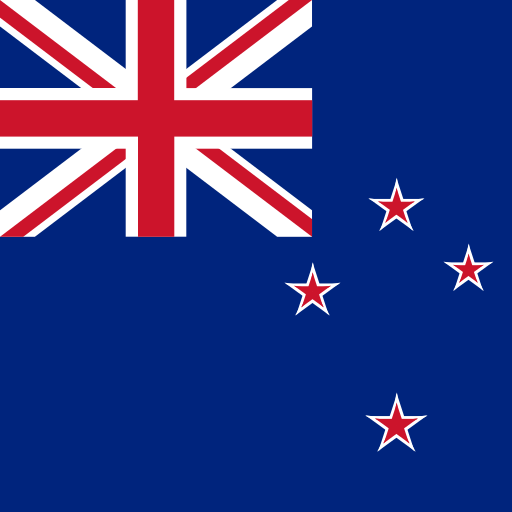
Flag of Newzealand

Emblem of Newzealand
Capital
Wellington
ISO 3166 Code
NZ
Population
4,554,230
Area, Sq KM
269,190
Currency
New Zealand Dollar
GDP, Billion USD
1,85,788
Language
Maori, English
GDP Growth Rate, %
3.6
Inflation, Avg CP, %
-
Interest Rates, %
-
Unemployement Rate, %
5.22
Exchange Rate, 1 USD Equals
1.45
International dial code
64
Time ZONE
GMT+12:00
Internet TLD
.nz
Get FREE SAMPLE TENDERS from Newzealand in your email inbox.
Copyright © 2014-2026 NewzealandTender.com. All Rights Reserved.